· articles · 8 min read
By Amit GuptaAPI Virtualization - Why is it winning?
API virtualization has replaced legacy service virtualization by focusing on contracts, not internals. This post talks how and why modern software development team virtualize APIs to beat dependency hell, SaaS limits, and costly sandboxes.

Dependency Hell Didn’t Disappear
If you take a step back and look at modern software development, it is tempting to believe that dependency hell should be a solved problem by now. You deploy to the cloud, spin up environments in minutes, and rely heavily on managed infrastructure. Yet in practice, teams still lose days waiting for downstream systems, blocked by third-party APIs, or struggling to reproduce issues that only occur outside their control.
What changed is not the existence of dependencies, but their nature!
Most critical dependencies today are no longer databases or internal services. They are APIs-external, rate-limited, owned by SaaS vendors, or controlled by other teams inside your organization. This shift is fundamental, and it explains why many of the tools and practices built for an earlier era now feel heavy, slow, and misaligned.
This is the context in which the debate between service virtualization and API virtualization needs to be understood.
Service Virtualization - History
Service virtualization emerged when systems were designed very differently. In large SOA or enterprise environments, services were stateful, deeply interconnected, and expensive to run. A single downstream service might depend on its own database, message queues, and complex business logic. Spinning up a realistic test environment often meant coordinating multiple teams and provisioning costly infrastructure.
Service virtualization tried to solve this by emulating entire services. The goal was to replicate behavior as closely as possible: internal logic, state transitions, workflows, and sometimes even data stores. For its time, this approach was logical. If your application depended on a complex internal service that you could not easily run, virtualizing that service felt like the right abstraction.
The problem is that this abstraction no longer matches how modern systems fail or how teams integrate.
Why Service Virtualization Breaks Down Today
Fast forward to modern architectures, most failures do not happen because a service’s internal logic behaves incorrectly. They happen because an API call times out, returns an unexpected response, enforces a rate limit, or behaves slightly differently across environments.
Service virtualization assumes that you need to model the internals of a dependency to test against it. In reality, your application does not see those internals. It sees a request and a response over a protocol. Anything beyond that boundary is implementation detail.
This mismatch leads to unnecessary complexity. Teams spend time modeling behavior they neither own nor control. Test setups become fragile, difficult to maintain, and tightly coupled to assumptions about how another system works internally. Ironically, the virtualization layer itself becomes a dependency.
As systems became more distributed and SaaS-driven, this approach stopped scaling.
What API Virtualization Actually Means
API virtualization takes a much narrower, more honest view of dependencies. It focuses exclusively on the contract between systems. That contract is defined by the protocol, the request structure, the response format, and the possible error conditions.
When you virtualize an API, you are not pretending to be the service. You are pretending to be the interface. From the client’s perspective, that is all that ever mattered.
This shift removes a large class of problems. You no longer need to care how data is stored, how workflows are implemented, or how state is managed internally. You only need to care about what your application sends and what it receives.
This idea may sound trivial, but it is precisely what makes API virtualization lightweight, robust, and scalable.
Evolution of Mocking and Virtualization (2005 → Present)
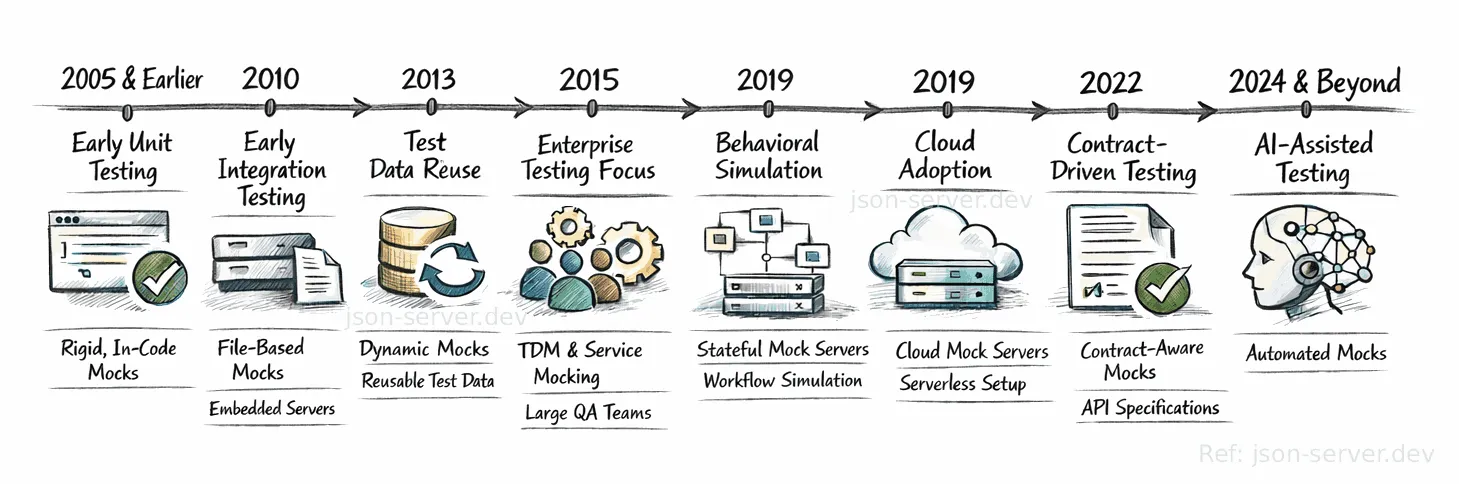
| Era | Approx. Year | Dominant Approach | What Teams Were Solving |
|---|---|---|---|
| Early unit testing | 2005 and before | Rigid, in-code mocks | Isolating classes and methods during unit tests |
| Early integration testing | 2010 | Static file-based mocks, embedded servers | Simulating HTTP dependencies with minimal setup |
| Test data reuse | 2013 | Dynamic mocks with reusable test data | Reducing duplication and manual fixture maintenance |
| Enterprise testing focus | 2015 | TDM and service mocking culture | Supporting large QA teams and centralized testing |
| Vendor-managed testing | 2017 | Sandboxed API environments | Offloading test infrastructure to SaaS providers |
| Behavioral simulation | 2019 | Stateful / DB-backed mock servers | Simulating workflows and persistence |
| Cloud adoption | 2019 | Cloud-native mock servers (SaaS + serverless) | Eliminating local infrastructure and setup friction |
| Contract-driven testing | 2022 | Contract-aware mocks + synthetic data | Aligning mocks with OpenAPI / AsyncAPI specs |
| Present day | 2024–present | AI-assisted response generation | Reducing manual mock configuration and edge-case modeling |
API Virtualization vs Service Virtualization in Practice
The technical difference between service virtualization and API virtualization becomes obvious once you look at real integration scenarios. When your application integrates with a third-party system, you typically have access to documentation, sample payloads, and maybe a sandbox. You do not have access to internal logic, databases, or execution paths.
Service virtualization tries to recreate what you cannot see. API virtualization embraces what you can.
By anchoring tests and development environments to the API contract, you decouple your work from assumptions about implementation. This makes your setup more stable, easier to evolve, and far closer to real-world behavior.
As systems continue to fragment across teams and vendors, this distinction becomes critical.
Everything Is an API Now
The dominance of APIs is not limited to third-party SaaS platforms. Internally, microservices communicate almost entirely through HTTP or asynchronous messaging. Even infrastructure components-databases, queues, object storage-are consumed through managed APIs.
The result is that modern systems are best described not as collections of services, but as networks of API calls. In this world, the API boundary is the only reliable integration point.
Virtualizing anything below that boundary adds complexity without increasing confidence. The API is where compatibility, failures, and performance characteristics surface. It is the natural place to isolate dependencies.
The Real Bottleneck: External APIs
One reason API virtualization is winning is that other categories of dependencies have become easy to manage. You can spin up a database clone in minutes. You can run Kafka or RabbitMQ locally or in the cloud with minimal effort. Infrastructure is no longer the constraint.
External APIs are different. You cannot clone Salesforce or ServiceNow. You cannot locally run Amadeus or a payment provider. These systems impose usage limits, restrict data, and charge per request. Their sandbox environments often lag behind production or disable critical features.
API virtualization gives teams back control. Instead of shaping their development and testing around the limitations of vendor environments, teams simulate the APIs they depend on and move forward independently.
API Specifications Powered Mocks
A major reason API virtualization is now practical at scale is the maturity of specification formats like OpenAPI, GraphQL, gRPC, AsyncAPI, kind of specifications. These formats provide machine-readable descriptions of endpoints, schemas, and behaviors.
With a well-defined spec, API virtualization becomes contract-driven rather than guesswork. Mock endpoints can be generated automatically. Requests can be validated. Responses can be shaped to match real-world expectations.
This tight coupling to the contract ensures that virtualization stays aligned with reality, even as APIs evolve.
Benefits of Contract-First Virtualization
| Benefit | Description |
|---|---|
| Shift Left | Start frontend and integration testing immediately after defining the contract, without waiting for the backend. |
| Parallel Development | Frontend and Backend teams work decoupled, meeting only at the agreed API contract. |
| Better DX | Developers can “try out” the API and understand its behavior interactively before writing a single line of integration code. |
| Stability | Mocks generated from specs ensure that test environments don’t drift from the actual implementation plan. |
| Fail Fast | Catch schema and contract violations early with automated request/response validation against the spec. |
SaaS Sandboxes
The Cost
SaaS vendors often position sandbox environments as a solution, but they come with high costs. They are shared, restricted, and frequently incomplete. Certain workflows are disabled. Data sets are unrealistic. API usage is capped or billed separately. So is this cost justified for dev-test environments?
For systems like Salesforce, ServiceNow, or Amadeus, these limitations directly affect developer productivity and test reliability. Software development teams end up working around the sandbox instead of focusing on business logic.
API virtualization shifts this center of gravity, by treating vendor sandboxes as critical infrastructure, they become optional reference points. Most development and testing happens against virtualized APIs that the team fully controls.
Dependencies Still Persist
The rise of AI and LLMs has not eliminated integration complexity. If anything, it has amplified it. AI-driven workflows often depend on multiple APIs and introduce nondeterministic behavior that is difficult to test against live systems. To make such systems testable, teams need deterministic, repeatable API behavior. API virtualization enables this by freezing responses, simulating failures, and removing variability from external dependencies.
API Virtualization Is Winning
API virtualization aligns with how software is actually built, tested, and deployed today. It is lightweight enough to fit into local development, powerful enough to support CI/CD pipelines, and focused enough to avoid unnecessary complexity. Modern tools that let you quickly stand up mock APIs, simulate responses, and control edge cases-without modeling entire services-fit naturally into this workflow. They solve the real problem: unblocking teams without introducing new dependencies.
Moving On from Service Virtualization
Service virtualization was a reasonable response to a specific set of historical constraints. Those constraints no longer define modern systems.
Today, the fastest and most reliable teams virtualize at the API layer. They treat contracts as the source of truth and accept that most dependencies are external and uncontrollable.
Choosing API virtualization is not just a tooling decision. It is an architectural acknowledgment of where complexity truly lives.
And that is why service virtualization is legacy, and API virtualization is reality. [Top]