· articles · 4 min read
By Ankit JainTOON: The New Darling of LLM Data or Just Another 'YADF'?
TOON (Token-Oriented Object Notation) is a new data serialization format designed to be LLM-native. Users have reported a 20-40% reduction in token usage for AI applications. Is it the future or just another 'Yet Another Data Format' (YADF)?
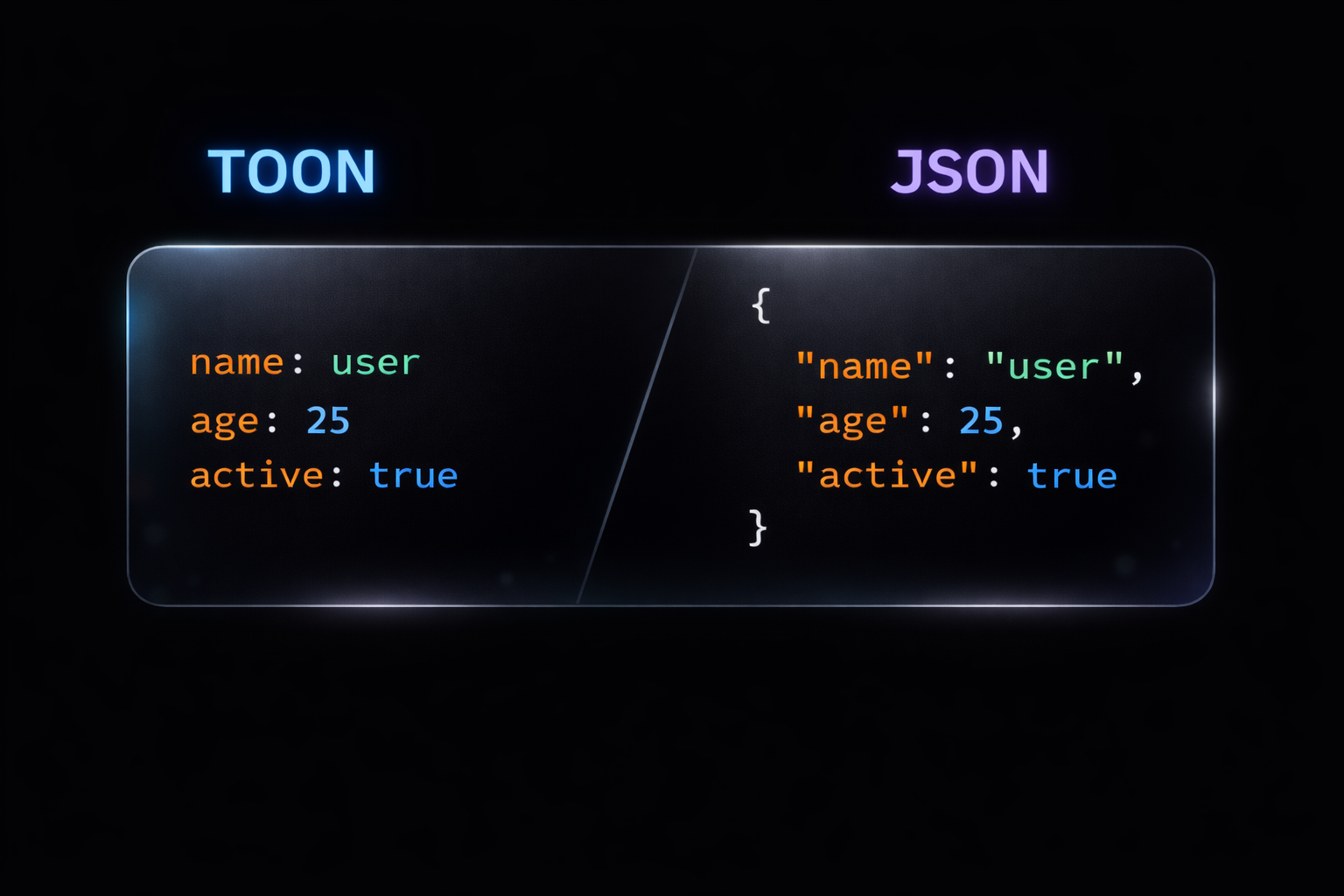
JSON has been the default data format for decades. It’s simple, consistent, and supported everywhere.
That changes when you start working with LLMs. JSON’s structure adds real cost: more tokens, smaller context limits, and a higher chance of parse errors.
TOON (Token Oriented Object Notation) focuses on that problem. It keeps data structured, but removes most of the brackets, quotes, and repeated keys. The result is lower token usage and fewer formatting issues.
Some developers see TOON as a practical improvement for LLM workflows. Others see it as a solution looking for a problem.
What is TOON?
TOON is a lightweight data serialization format specifically designed to be “LLM-native.” Unlike JSON or XML, which were built for machine-to-machine communication, TOON is optimized for the way LLMs process text: tokens.
By stripping away the syntactic sugar (curly braces, square brackets, quotation marks), TOON aims to reduce the overhead of data representation.
Key Characteristics of TOON:
- Minimal Syntax: It uses indentation and simple delimiters (colons or dashes) rather than nested brackets.
- Token Efficient: By reducing character counts, it allows more data to fit into an LLM’s context window.
- Reduction in Syntax Errors: LLMs often struggle with closing brackets in complex JSON structures; TOON’s flat or indentation-based structure minimizes these “hallucinated” syntax errors.
Why the Hype? The Case for TOON
The primary argument for TOON is efficiency. For developers building LLM-integrated applications, every token saved is money earned and context gained.
1. Token Economy
In a standard JSON object, a significant portion of the token count is “wasted” on structural characters ({, ", :, ,). In high-volume applications, switching to TOON can reduce token usage by 20-40%, directly lowering API costs.
2. Readability for Machines
LLMs perceive text as tokens. A complex JSON object can be fragmented into many tokens that don’t hold semantic value. TOON aligns more closely with the natural language patterns LLMs are trained on, making it easier for the model to “understand” and generate data correctly.
3. Potential Use Cases for Embedded Systems
The developer community has noted that lightweight formats are a “godsend for embedded systems”. When you have limited memory and processing power, the overhead of a JSON parser is a luxury. TOON offers a middle ground between the rigidity of Protobuf and the verbosity of JSON.
Is TOON Solving the Wrong Problem?
Despite the excitement, critics argue that TOON might be a distraction from better architectural practices. This critique centers on the concept of ‘Yet Another Data Format’ (YADF).
Architectural Critique:
- Data vs. Intent: Critics argue that prompts should carry intent and instructions, while the actual heavy lifting of data should happen in the “data plane” or through APIs.
- The Context Window Trap: Sending massive payloads into a context window is often a sign of poor RAG (Retrieval-Augmented Generation) design. If you stop using the prompt as a database, JSON’s verbosity becomes irrelevant.
- Tooling Maturity: JSON has a massive ecosystem of validators, parsers, and schemas (JSON Schema). TOON lacks this infrastructure, which can lead to a data handling scenario where errors are harder to catch.
TOON vs. JSON: A Quick Comparison
| Feature | JSON | TOON |
|---|---|---|
| Readability | High (Human) | High (LLM & Human) |
| Syntactic Overhead | High (Brackets/Quotes) | Minimal |
| Token Efficiency | Lower | Higher |
| Schema Support | Robust | Nascent/None |
| Parsing Effort | Standardized | Custom/Simple |
TOON in Action: A Visual Comparison
Let’s look at a quick comparison. Imagine a user profile with some recent orders. In JSON, you’re paying a “token tax” for every recurring key and bracket.
{
  "user": "alex_dev",
  "role": "admin",
  "active": true,
  "orders": [
    {"id": 101, "item": "Mechanical Keyboard", "price": 120},
    {"id": 102, "item": "USB-C Hub", "price": 45}
  ]
}
Now, look at how TOON handles the same data. It strips the noise and treats repeated data like a spreadsheet layer. It’s noticeably cleaner for both you and the LLM.
user: alex_dev
role: admin
active: true
orders[2]{id,item,price}:
  101,Mechanical Keyboard,120
  102,USB-C Hub,45
Conclusion
TOON isn’t going to replace JSON as the universal standard tomorrow. And it doesn’t have to. It is a specialized tool for a specific job.
Think of it this way: JSON is for systems; TOON is for tokens.
If you are building LLM-heavy apps where prompts are bloated with data just to be read and reasoned over, TOON can pay off: The token savings are real, model outputs return back cleaner making it a viable option there.
But if your system already keeps prompts lean with tools and APIs doing the data work, TOON adds nothing to the equation. JSON was, has and will stay the safer choice with all its tooling.
The mistake here isn’t trying TOON. The mistake is switching without doing a calculated assessment. You need to test your payloads, check token counts, costs, parse errors and latency. If TOON actually satisfies those benchmarks against JSON in your workflows, use it, else, stick with what works.
In the end, file formats are just tools for storing information. You need to pick the right one for the job.